
Chair-type measuring device
SenseChair
Seated body-sway measurement device
A chair-type sensor that measures rapport between people
Sold mainly for research and development use.
If you are a company interested in joint research or business co-creation, or a researcher who would like to use it in experiments, please feel free to contact us.
What it does
Record body sway just by sitting
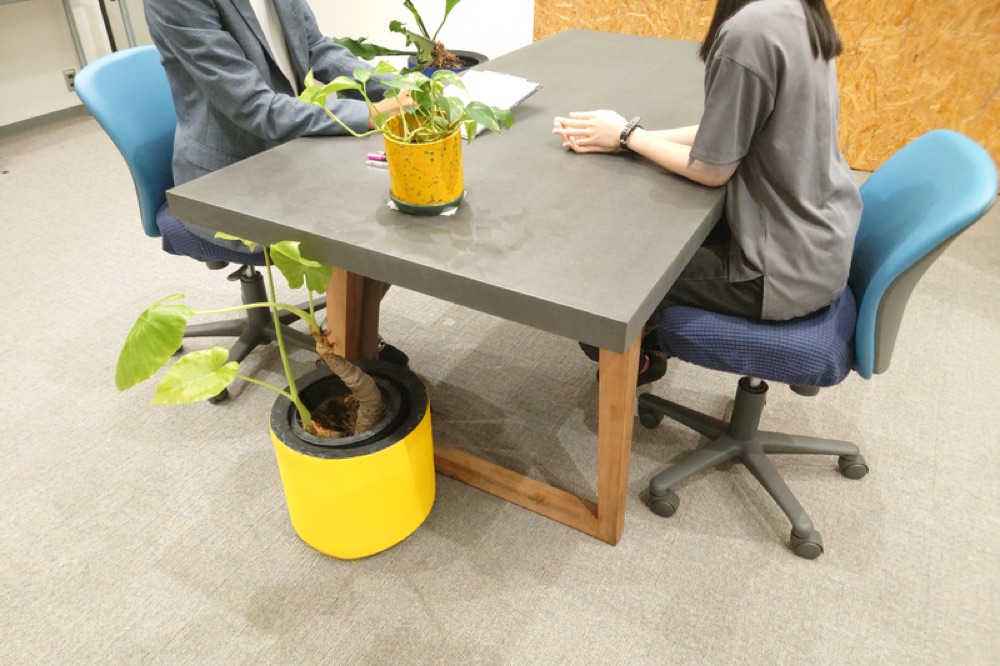
SenseChair is a chair-type measuring device. Built-in 16-bit strain sensors in the seat record the load and the sway of the center of gravity of the person sitting on it. Nothing needs to be worn or operated. It looks like an ordinary office chair.
With several chairs, you can also examine how closely people's body movements synchronize in a meeting or conversation.
The device grew out of research on "unconscious computing," which recognizes a person's state and situation in order to support them. Research on it has accumulated since 2009.
What it measures is body movement and response. It is not a device that directly reads the sensations or emotions of the person sitting.
Data
Available data
You can record the position of the center of gravity (X and Y) and the load as time series from several chairs at once, and check them on a real-time graph. Data can be exported as CSV, and we can also customize the dedicated analysis software.
Center-of-gravity coordinates (X, Y)
Where the body weight rests on the seat, and how that position sways.
Load (W)
The load of the seated person, and how it changes.
Simultaneous measurement with several chairs
Record the body movements of several people in the same place on a common time axis, and examine the tendency to synchronize.
Real-time display and CSV export
Check the graph during measurement in the PC data acquisition app. Recordings can be exported as CSV.
Use cases
Intended scenarios
Research is where it is used most so far. For the other settings, we are looking for people to try it out with us. "How it can be used" describes our ideas for use.
Research
Education, ergonomics, behavioral science, psychology, social behavior, medicine, nursing care and rehabilitation
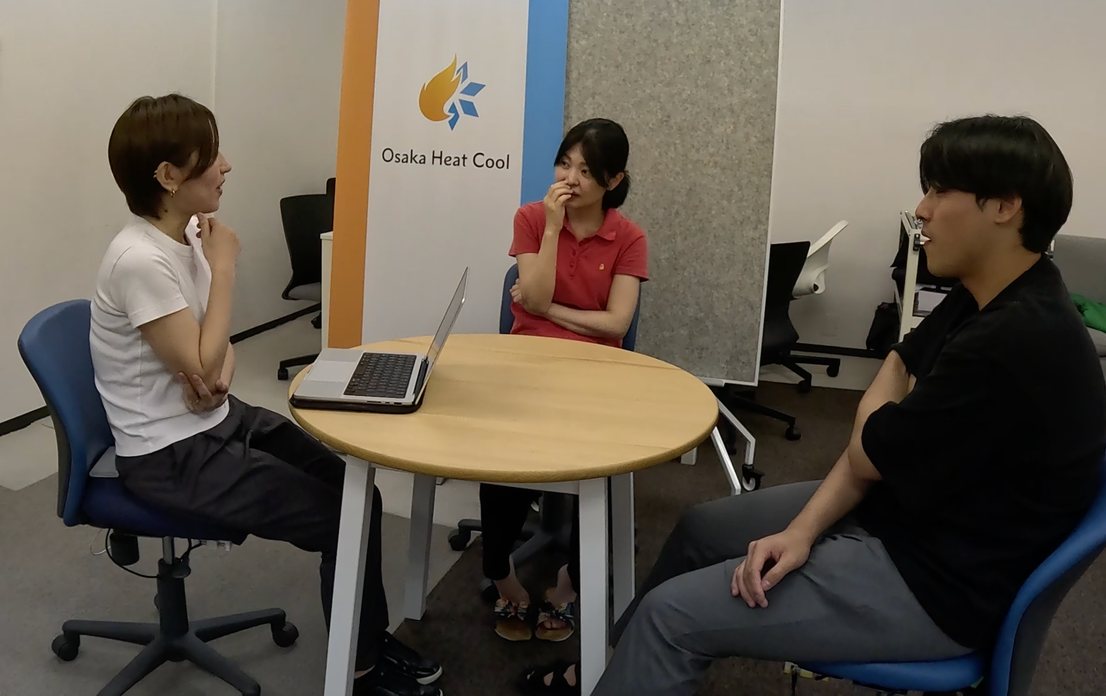
As an outcome measure in research on how lively a discussion is or how well people concentrate. For analyzing center-of-gravity shifts and posture while seated.
How it can be used
Participants only need to sit, and their body movements are recorded as an objective measure. You can line up and compare "how lively the group is" and "how focused people are," which questionnaires alone capture poorly, as numerical waveforms. With several chairs, you can even measure synchrony between people.
Office and HR
Teams working on meetings, training and office improvement
Evaluating how lively in-house training and events are, evaluating how active discussion is in meeting rooms, visualizing excitement in meeting minutes, and measuring the effect of office improvements (concentration, fatigue and so on).
How it can be used
Before and after a meeting or training session, you can visualize how lively or focused the group was as synchrony of body movement. When you change the layout or the way a session is run, you can compare the difference from records instead of impressions. It becomes one yardstick for checking the effect of office improvements.
Education
Educational institutions, cram schools and EdTech companies
Use in the PDCA cycle of a business, and evaluation of students' non-cognitive skills in inquiry-based learning.
How it can be used
One possible use is to see, from how students move while seated, how engaged they are in a lesson or an inquiry-based activity. You can record the change when you alter how a class is run and use it to improve lessons.
Research
Research
SenseChair started from research that used the center of gravity and weight on the seat to know a person's state. The research then moved on to individual states, and then to synchrony between people. Here the papers are grouped by theme and listed in order of publication.
Measuring how people sit
2009–2012
Basic research on whether a seated person's posture and state can be identified from the center of gravity and weight on the seat.
A study on identifying sitting states using center of pressure and weight [in Japanese] (external site)
Summary
- A study on identifying a seated state using the center of gravity and weight on the seat (from the title).
A study on posture recognition rates from center of pressure and weight on various chairs [in Japanese] (external site)
Summary
- Using machine learning, the authors examined how well seated postures can be identified from the center-of-gravity and weight information on the seat, across various chairs (from the title and our seminar slides).
A basic study of sensing toward a system that corrects distorted sitting posture [in Japanese] (external site)
Summary
- A basic study of sensing for a system that corrects distorted sitting posture (from the title).
Exploring individual states
2013–2014
Research on whether a seated person's state (drowsiness) can be detected from the center of gravity and weight on the seat.
A study on drowsiness detection using SenseChair [in Japanese] (external site)
Summary
- A study on detecting a seated person's drowsiness using SenseChair (from the title).
A study on drowsiness detection using SenseChair [in Japanese] (external site)
Summary
- Data were collected over 5 days from six men in their twenties doing ordinary desk work (such as reading and using a PC), and the authors examined whether two states, wakefulness and sleep, could be identified (from the research introduction in our 2025 seminar slides).
Measuring synchrony between people
2013–2024
Research on the synchrony of body sway among several people in conversation, discussion and musical performance, and its relation to how lively the setting is, to the performance, and to how ideas come out.
Measuring synchrony tendency using SenseChair [in Japanese] (external site)
Summary
- A study on measuring the tendency to synchronize using SenseChair (from the title).
A study on measuring the liveliness of group conversation using SenseChair [in Japanese] (external site)
Summary
- A study on measuring how lively a group conversation is (its activity level) using SenseChair (from the title).
Detecting synchrony between conversation partners with SenseChair [in Japanese] (external site)
Summary
- In 14 groups of three (42 people), participants did a task of broadening opinions, and the liveliness of the session and their engagement in the task were rated by questionnaire. The results showed that the tendency for body-weight changes to synchronize affected how lively the session was (from the research introduction in our 2025 seminar slides; participants were not told that SenseChair was being used).
Detecting synchrony between conversation partners with SenseChair and evaluating conversation quality [in Japanese] (external site)
Summary
- A method for detecting the tendency to synchronize among people talking on several SenseChairs, and an evaluation of conversation quality based on that tendency (from the title).
Ensembility among musicians according to their swaying movements and its relationship with musical performance (external site)
Summary
- The authors derived a "performance coordination level" from the body sway of three professional musicians (saxophone, koto and piano). Twenty-one university students listened to performances with high and not-high coordination and rated them. The results suggested that a high level of physical synchrony between performers may be partly related to how listeners evaluate the performance (from the research introduction in our 2025 seminar slides).
Detection of nodding of interlocutors using a chair-shaped device and investigating relationship between a divergent thinking task and amount of nodding (external site)
Summary
- Using a chair-type device, the authors detected the nodding of people in conversation and examined the relation between the amount of nodding and a task of broadening ideas (from the title).
The association between synchrony and intellectual productivity in a group discussion: a study using the SenseChair (external site)
Summary
- In group discussions, the authors examined the relation between synchrony among participants and the group's intellectual productivity (such as the number of ideas produced). A positive correlation close to significant was found: the higher the average pairwise synchrony, the more ideas the team produced. They state that looking at local pairwise synchrony, and not only synchrony of the whole group, seems worthwhile (from the abstract).
For the full text and details of each paper, please see the linked page. The summaries are written from each paper's abstract or title and our 2025 seminar slides.
Partners
Partner recruitment
SenseChair is used in research, but turning it into a business is still ahead of us. Its strength is measuring changes between people from the natural act of sitting. We would like to grow it into a business together with companies, through joint research.
University faculty and researchers
Please use it as a measuring instrument for your experiments and surveys. We also welcome requests to develop hardware for research and demonstrations, joint research, and consultations on using research funds or grants.
Companies
We are looking for companies that will try it in settings such as meetings, training, education and welfare as joint research, and turn it into a business. From setting the research theme to demonstration and productization, we and university researchers will work alongside you.
Spec
Specifications and terms
- Contents
- Chair-type sensing device, USB cable, instruction manual
- Sensors
- Strain sensors (load detection). Optional 6-axis accelerometer and gyroscope
- Load sensor capacity
- Up to 130 kg
- Resolution
- 16 bit
- Power
- Built-in battery (about 6 hours of continuous use) or USB power (5 V)
- Connectivity
- USB Type-A / Bluetooth
- Output
- CSV (dedicated analysis software can be customized)
- Size and weight
- About W45 × D45 × H80 cm / about 12 kg
- Price and lead time (guide)
- From JPY 300,000 per unit; lead time about 1 month
Specifications and appearance may change without notice. Price and lead time vary with the configuration and the number of units. Please contact us.
Contact
Inquiries and requests for materials
For adoption in research or experiments, questions about specifications, requests for hardware development, and joint research, please use the contact form.
Contact formIdeas for use and a detailed product description are in our product brochure (PDF).
Product brochure (PDF) (external site)